
I am Jiayi Chen, a PhD researcher in Computer and Information Engineering at the Chinese University of Hong Kong, Shenzhen, advised by Prof. Guangxu Zhu and Prof. Shuai Wang. My work studies how foundation models and embodied systems can turn uncertain observations and open-ended language into decisions that are grounded, verifiable, and executable.
🧭 Research interests
- Fast–slow thinking for embodied systems: connecting deliberate large-model reasoning with reliable, real-time planning and control.
- Vision-and-language navigation: grounding visual observations and language instructions into reachable goals, map evidence, and executable actions.
- Foundation models × wireless sensing: learning transferable representations for heterogeneous CSI, and exploring the interface between wireless signals, perception, and AI.
Since May 2026, I have been working with AgiBot–AGIQUAD on a vision-based VLN algorithm. I lead the development of the perception-and-language grounding pipeline, which is being prepared for deployment on the AGIQUAD D2 Max and an ICRA submission.
🔥 News
- 2026.06: Released the preprint The Universal Language of CSI, accepted for publication in IEEE Communications Magazine, introducing a unified CSI foundation-model interface for cross-device and cross-environment wireless sensing.
- 2026.05: Joined AgiBot–AGIQUAD as an embodied-intelligence research intern, developing vision-language navigation for real-robot deployment.
- 2026.01: Agentic Fast–Slow Planning accepted to ICRA 2026, coupling large-model reasoning with semantic A* planning and real-time MPC control; the related patent was granted.
- 2025.06: Opportunistic Collaborative Planning published at IROS 2025, combining local/cloud vision-language models with decision-aware query timing for open-world driving.
🔬 Research
Embodied intelligence · fast–slow thinking
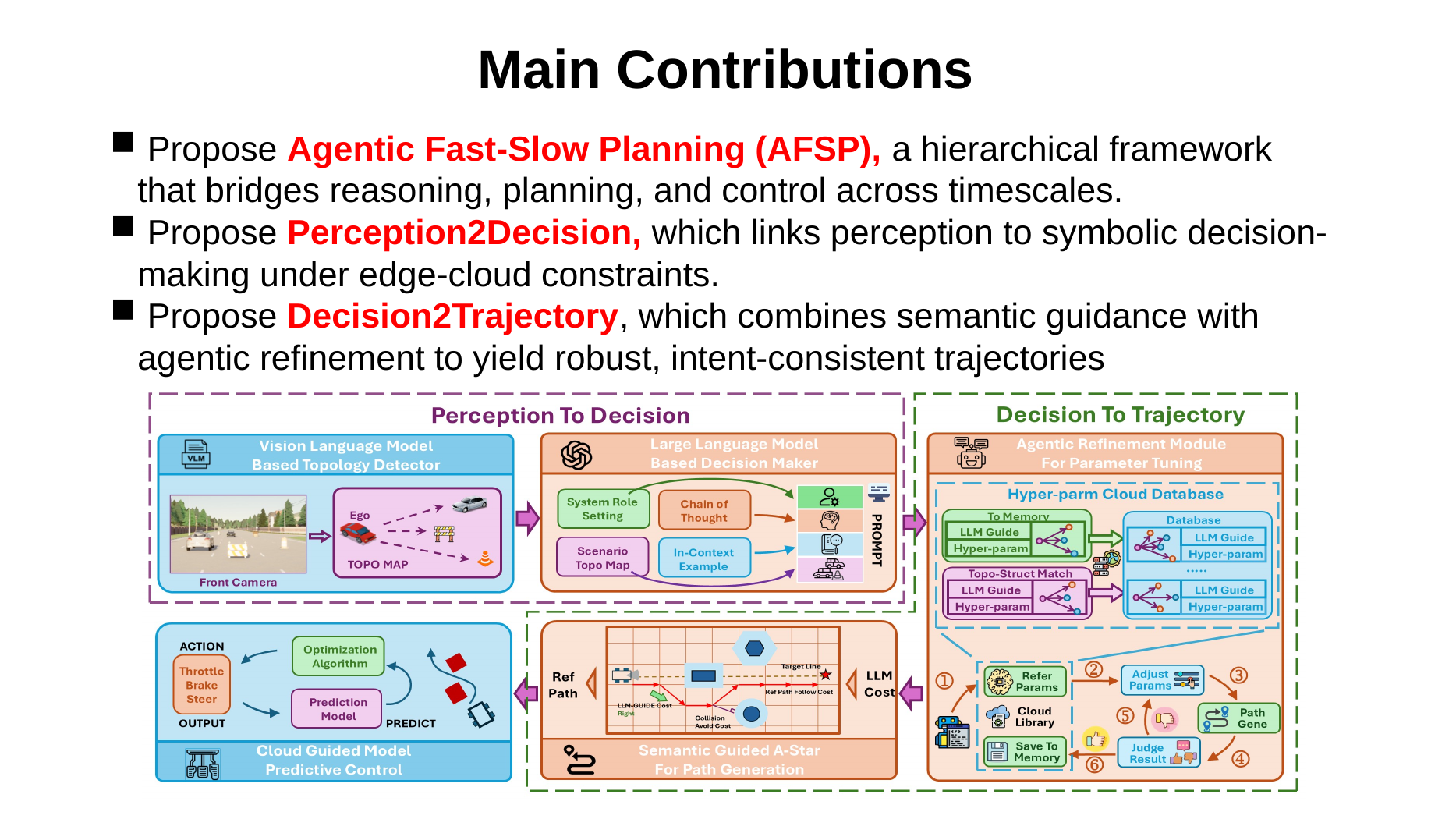
Bridging Large-Model Reasoning and Real-Time Control via Agentic Fast–Slow Planning
Agentic Fast–Slow Planning (AFSP) connects deliberative reasoning with real-time control, using perception-to-decision and decision-to-trajectory modules for robust autonomous driving.
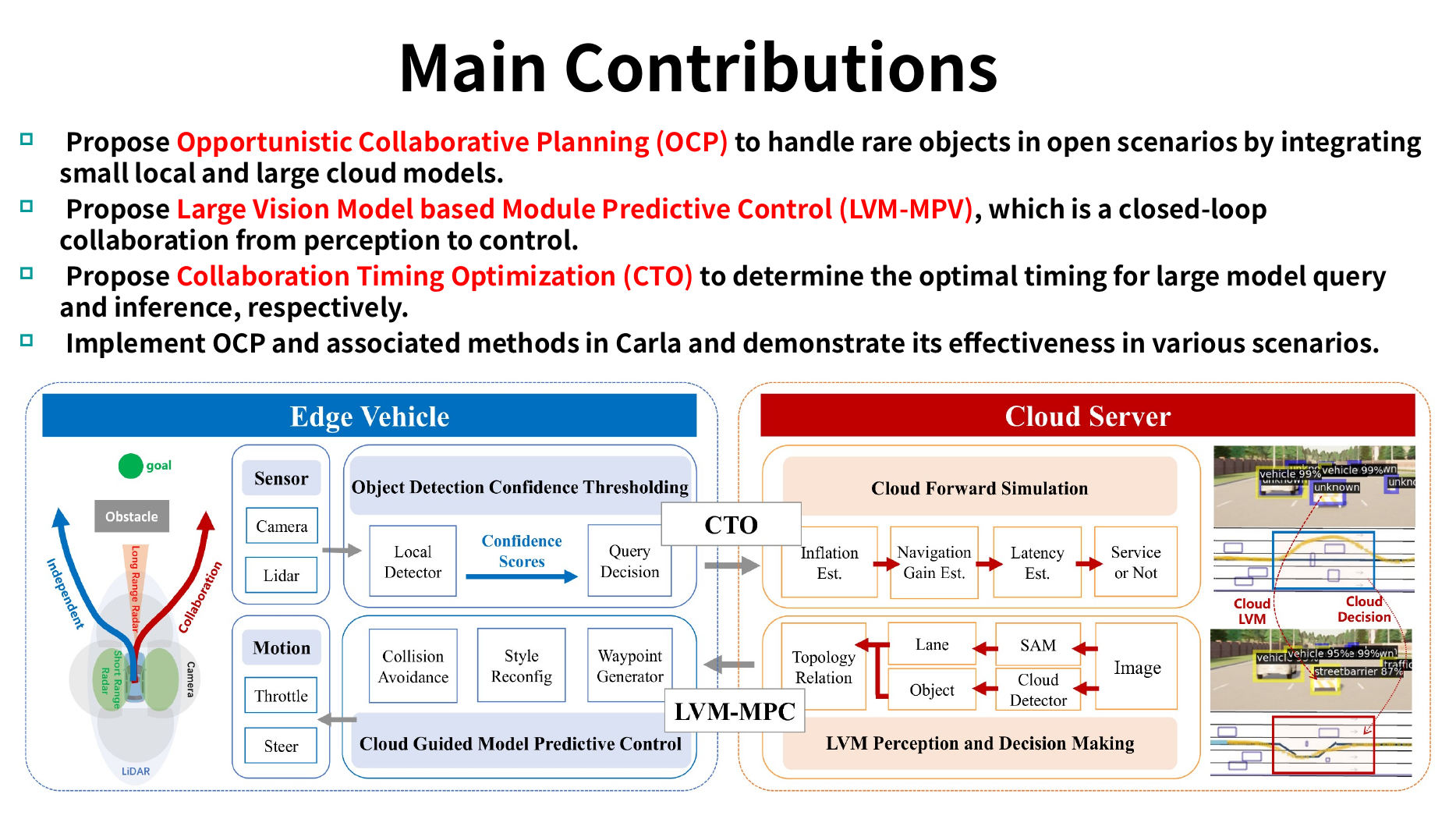
Opportunistic Collaborative Planning with Large Vision Model Guided Control and Joint Query-Service Optimization
Combines a local model with a cloud vision-language model, choosing when to query and how to close the loop from rare-object perception to vehicle control.
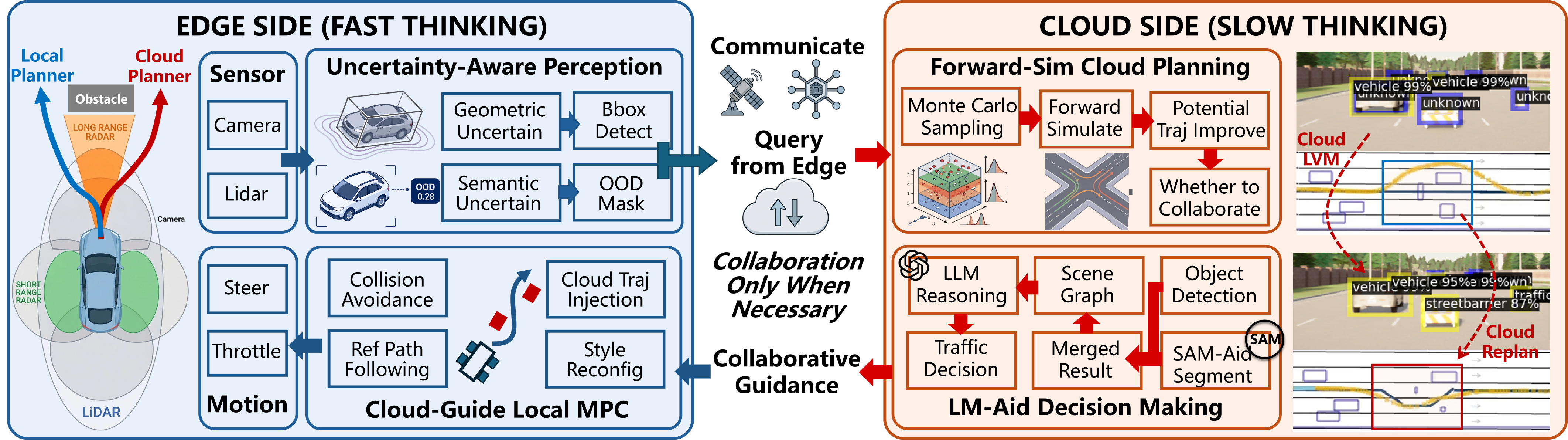
Not All Uncertainty Matters: Simulation-in-the-Loop Fast–Slow Reasoning for Decision-Critical Autonomous Driving System
A simulation-in-the-loop fast–slow reasoning pipeline that spends computation on uncertainty that can change a driving decision, rather than treating every prediction equally.
Toward foundation models for wireless sensing
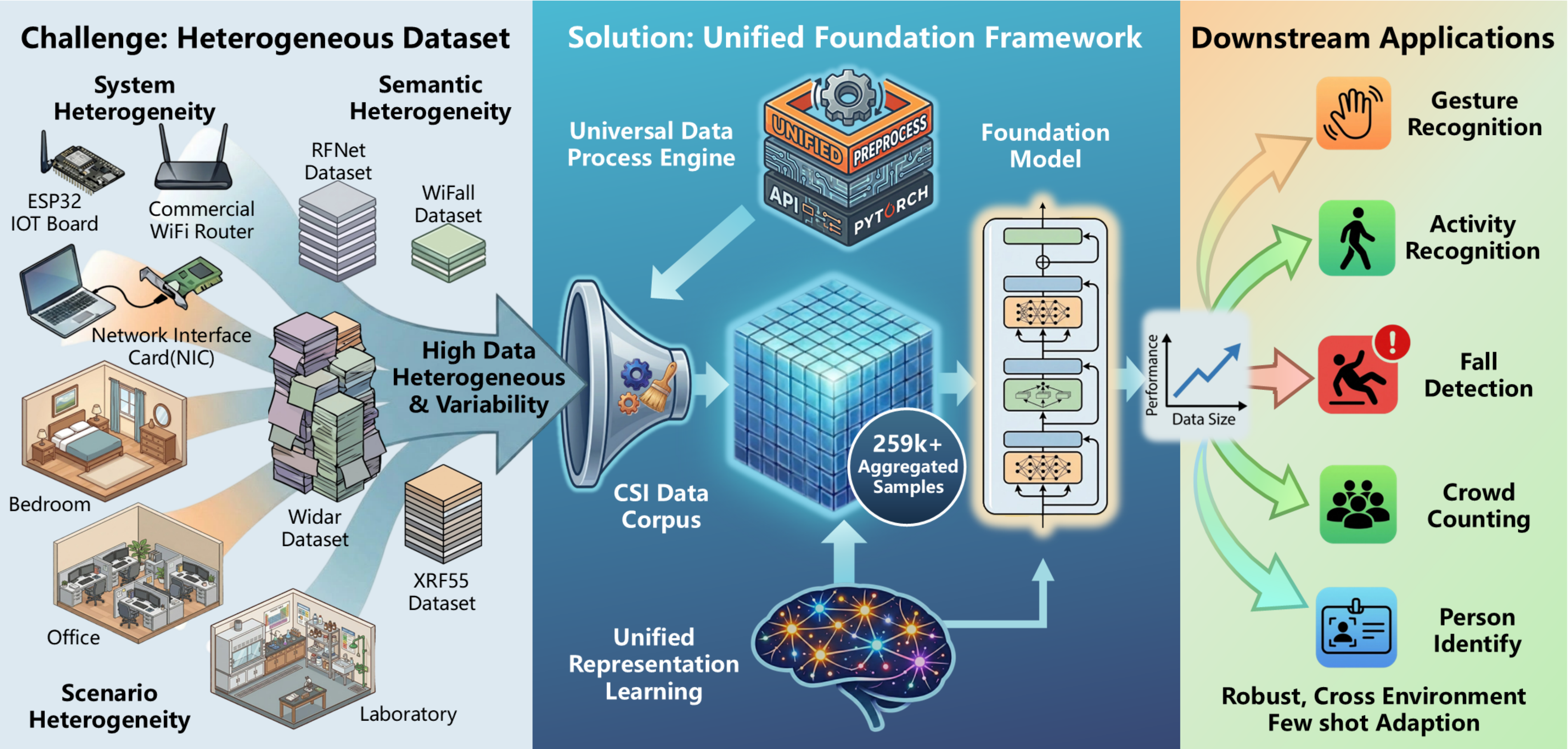
The Universal Language of CSI: Unifying Wireless Sensing Across Devices and Environments
Wireless signals carry rich information about the physical world, but sensing systems remain fragmented across devices, environments, and tasks. WiLLM explores a foundation-model approach to universal wireless-sensing representations: we curate a 259,774-sample heterogeneous CSI corpus spanning 12 real-world datasets and 6 task categories, then learn shared representations for cross-device and cross-environment transfer.
💼 Internship experience
Embodied Intelligence Research Intern · supervised by Qiwei Xu
Leading a vision-based VLN algorithm that grounds open-ended instructions in visual observations, reachable goals, and map evidence.
Developing the perception-and-language grounding stack toward deployment on the AGIQUAD D2 Max, with real-robot validation across floors.
Remote Research Intern · supervised by Xinyu Cai
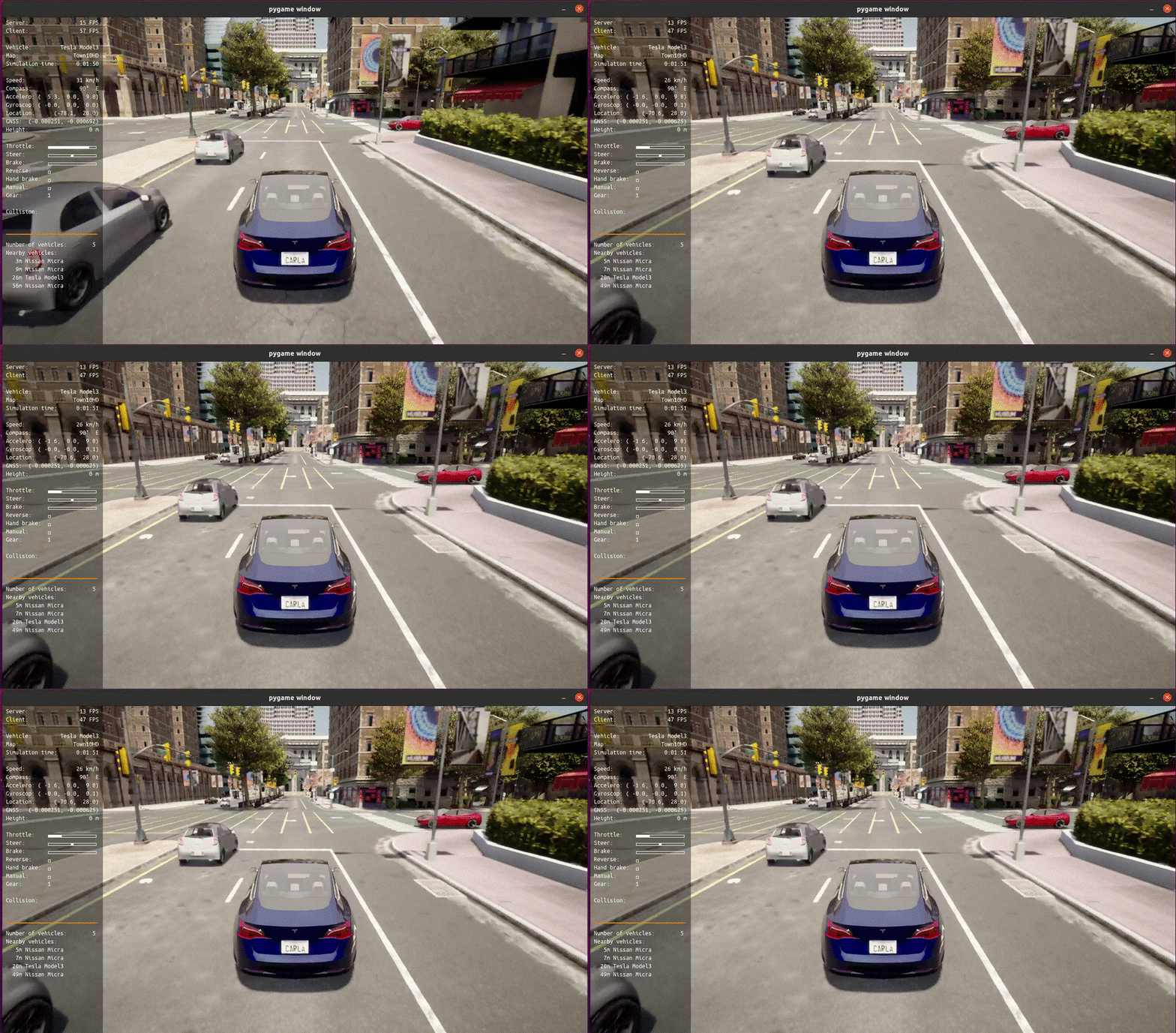
Built an LLM-based traffic-scenario generator that converts natural-language requirements into OpenSCENARIO cases, with generator–judge agents for initial-point selection, control-code generation, and XML output.
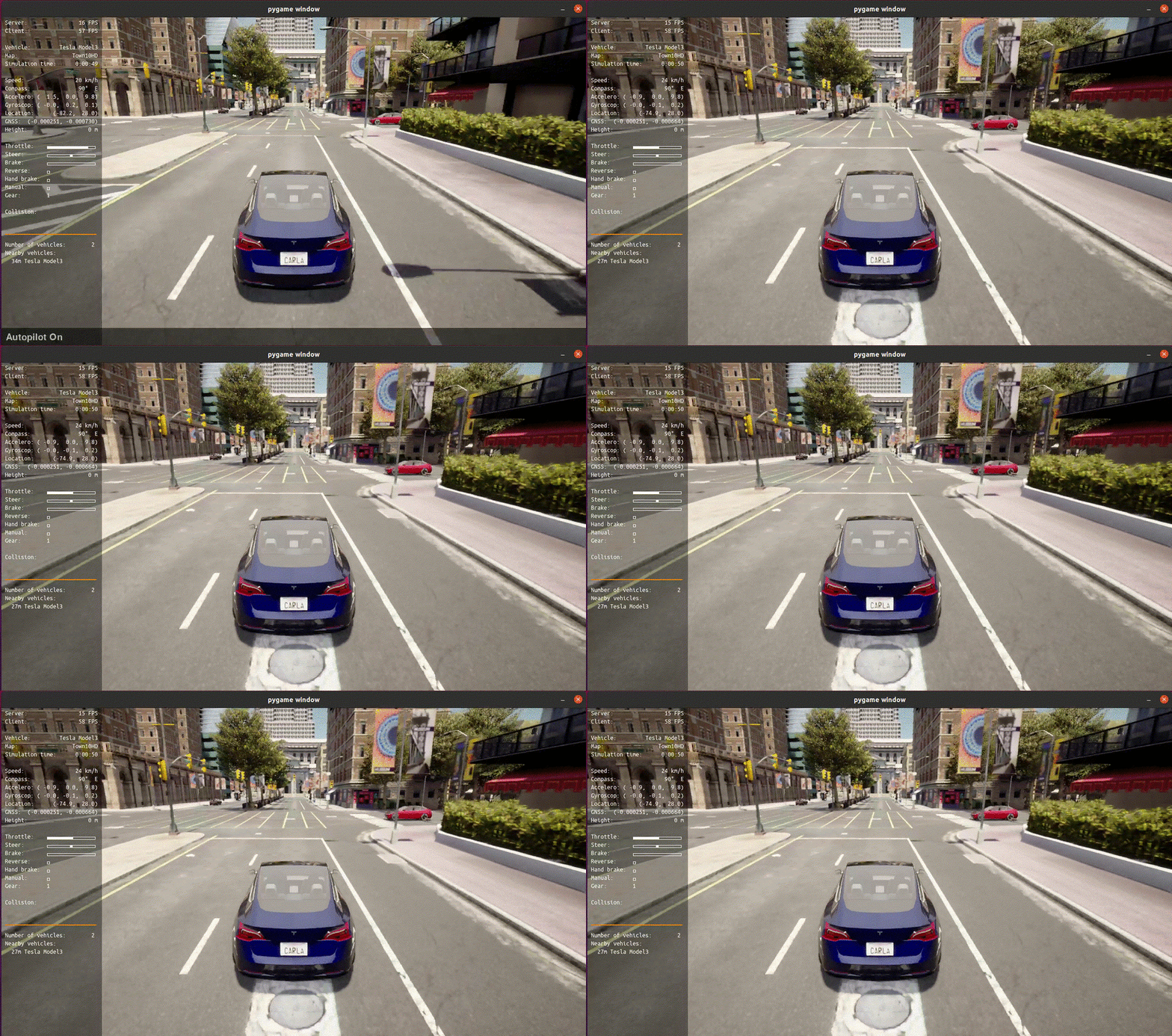
Configured CARLA–Apollo communication and built Waymo-to-V2X-ViT conversion scripts to support autonomous-driving simulation and downstream evaluation.
Generated and quality-checked InternVL VLM-OCR training data through difficult-sample synthesis, rule-based filtering, and parameter-freezing fine-tuning.
Data Analyst Intern · Channel Planning and Forecast
Developed Python/C++ allocation and reporting automation for China retail channel planning.
Automated weekly iPad allocation, pricing, and launch reporting workflows, reducing a 1M+ unit planning run to roughly two minutes.
🧩 Projects
6G Network Digital Twin
Built a Sionna RT-based virtual–real digital-twin pipeline by fusing RGB imagery with LiDAR point clouds to recover scene geometry and surface semantics. Used SAM-assisted semantic projection to initialize candidate material groups and calibrate electromagnetic parameters against sparse RSRP measurements.
Closed the loop by simulating line-of-sight, reflection, scattering, and transmission paths, comparing predicted and measured radio maps, and updating material parameters. Semantic affinity and radio-exposure consistency guided parameter sharing while limiting overfitting under sparse measurements.
Multi-Sensor UAV Docking and Adaptive Cruise Control
Led the system design and integration of a multi-sensor UAV platform for aerial docking and adaptive cruise control, including PnP-based visual localization for centimeter-level docking.
📖 Education
- 2024.09 – present, PhD in Computer and Information Engineering, The Chinese University of Hong Kong, Shenzhen.
- 2020.09 – 2024.06, B.Eng. in Internet of Things Engineering, Beijing University of Posts and Telecommunications.
🧾 Patent
- CSI-Based Target Detection Method, Apparatus, Device, and Medium, Chinese invention patent, ZL 2026 1 0612628.X (CN 122160804 B); granted July 24, 2026.
- Method and Related Device for Autonomous-Driving Path Planning Integrating Large-Model Reasoning, Chinese invention patent, ZL 2026 1 0345449.4; related to the AFSP/ICRA work.
🎖 Honors and Awards
- 2024: Outstanding Undergraduate Thesis, Queen Mary-BUPT Joint Programme.
- 2022: China International “Internet+” Competition, BUPT Industrial Track Second Prize.
- 2021: First Prize, National College Mathematics Competition.